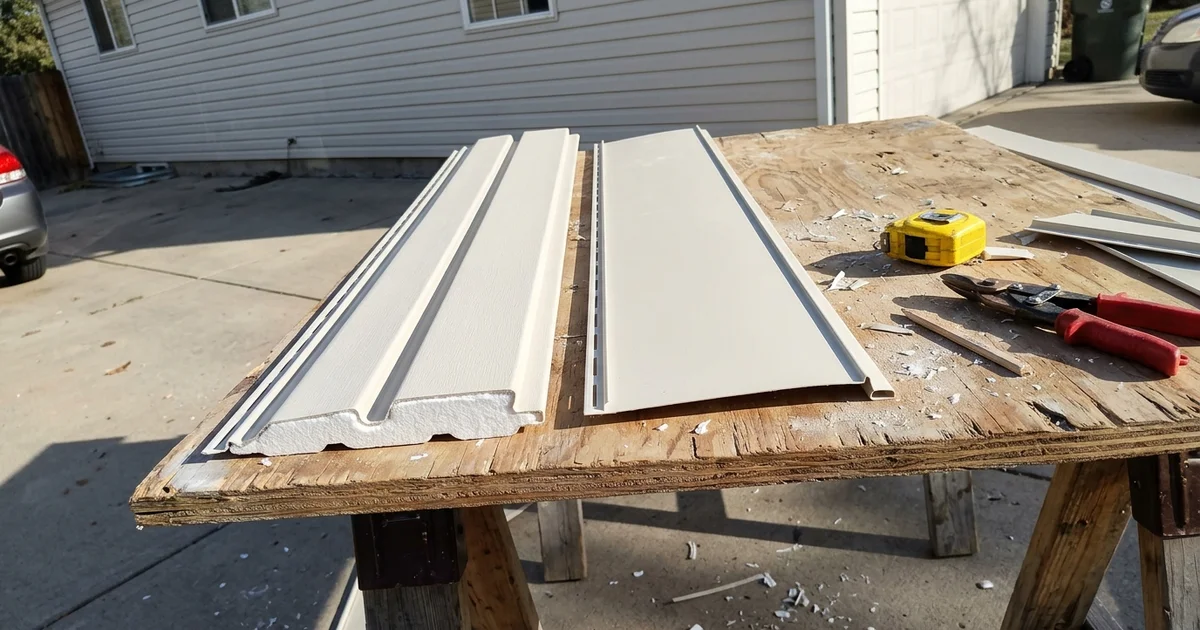
Two Kinds of Vinyl Panel
When you’re choosing vinyl siding, the panel itself is one of the first calls to make: insulated or standard. Insulated vs standard vinyl siding comes down to what’s on the back of the panel.
A standard panel is a single shaped sheet of vinyl, hollow behind each course. An insulated panel has that same vinyl face with foam bonded to the back, filling the hollow. That’s why you’ll also hear it called foam backed vinyl siding.
The foam is usually a rigid foam board shaped to fit the back of each course. It adds stiffness and thickness, and it changes how the panel behaves on the wall.
Both lock together the same way and hang on the same kind of nail hem. They also finish at the same corners and J-channel.
The difference is in how the panel feels, how it sits on the wall, and how it looks up close. Below, we’ll cover feel, dents, trim fit, and a side-by-side table, then help you pick one.
Stiffness and Feel Against the Wall
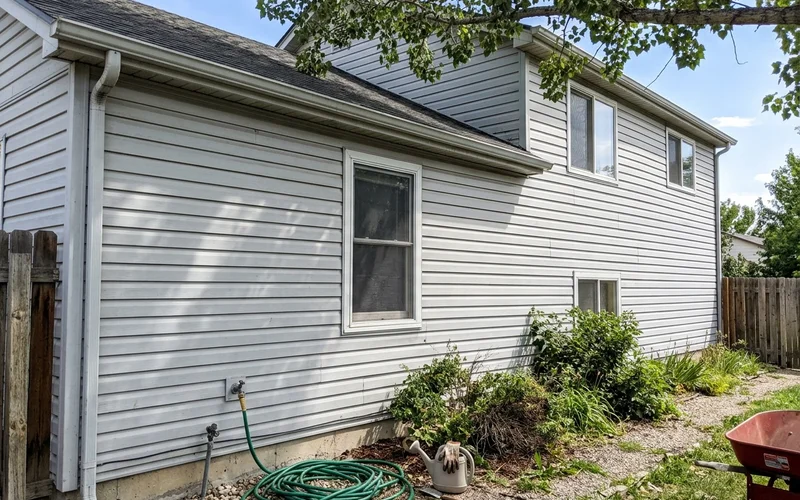
An insulated panel is stiffer than a standard one, and you can feel it the moment you pick one up. A standard panel is a thin sheet shaped into courses. It bends easily until it’s locked onto the wall, and even then it spans the wall with air behind each course.
The foam backing on an insulated panel fills the space behind the face. The panel sits solid against the wall instead of floating over it. Press on a standard panel and you can feel it give into the hollow. Press on an insulated panel and there’s foam behind your hand.
That solid feel is the main thing people notice when they compare the two in person.
Dents and a Flatter Look
Insulated panels hold their shape better when something presses on them, because the foam supports the face behind it.
Here’s what tends to push in a hollow panel more easily:
- A ball
- A ladder leaning on the wall
- A bump from a mower
The foam also helps the face stay flatter across a long wall. On a standard panel, small dips in the wall behind can show through as waves in the siding. They’re most visible when the sun hits the wall at a low angle. Foam backing bridges some of those dips, so a long run reads straighter.
Neither panel makes vinyl immune to damage. Hail can still crack and hole vinyl, insulated or not, and our hail damage siding repair page covers what a storm does to siding.
Fit at Trim
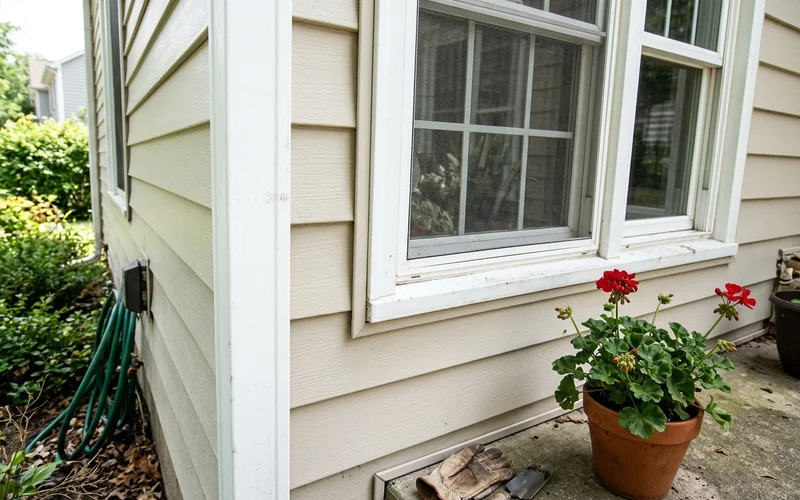
Insulated panels need deeper trim than standard panels. The foam adds thickness to the back of the panel, and that matters where the siding meets trim: J-channel around windows and doors, corner posts, and the starter strip at the bottom of the wall.
Standard panels fit standard trim pieces. Insulated panels need trim with enough depth to take the thicker panel, so the ends seat properly and still have room to move. That usually means wider J-channel, and around some windows the trim has to be built out so the thicker siding doesn’t stand proud of the window jamb.
Vinyl moves as the temperature changes, so every panel needs room to move, foam or no foam:
- A small expansion gap at each panel end, inside its trim
- Nails left a hair loose, so the panel can slide instead of buckling
On a re-side, we plan this from the start, and the trim is chosen to match the panel. On a repair, it’s one more reason we look at what’s already on the house before matching a new piece to it.
Insulated vs Standard Vinyl Siding Side by Side
Here’s the short version of everything above.
| Standard vinyl | Insulated vinyl | |
|---|---|---|
| Back of the panel | Hollow behind each course | Foam bonded to the back |
| Feel on the wall | Flexes, floats over the wall | Stiffer, sits solid against the wall |
| Dents from bumps | Pushes in more easily | Foam supports the face |
| Long walls | Dips in the wall can show as waves | Reads flatter across a long run |
| Trim | Standard J-channel and corner posts | Trim deep enough for the thicker panel |
| Repairs | Simpler panel to match and swap | Replacement pieces need the same foam backing |
Which One Fits Your House
Choose standard vinyl if you want the simplest panel and the wall behind it is flat and sound. Choose insulated vinyl if you want a stiffer panel that feels solid, resists everyday bumps better, and looks flatter on long walls.
Insulated panels cost more than standard ones, and the deeper trim adds to that. The better reasons to choose them are the feel, the straighter look on long walls, and the way the face holds up to everyday bumps.
Inside Fort Collins city limits, new vinyl of either kind needs a permit and has to go over a fire-rated wall. Our vinyl siding page explains that rule and shows the price range for a whole house. If you’re still weighing materials, the Fort Collins Siding Contractors homepage lists every siding we put on.
On your free estimate, we can bring both panel types so you can feel the difference between insulated and standard vinyl siding for yourself. Send the estimate form below to set it up.